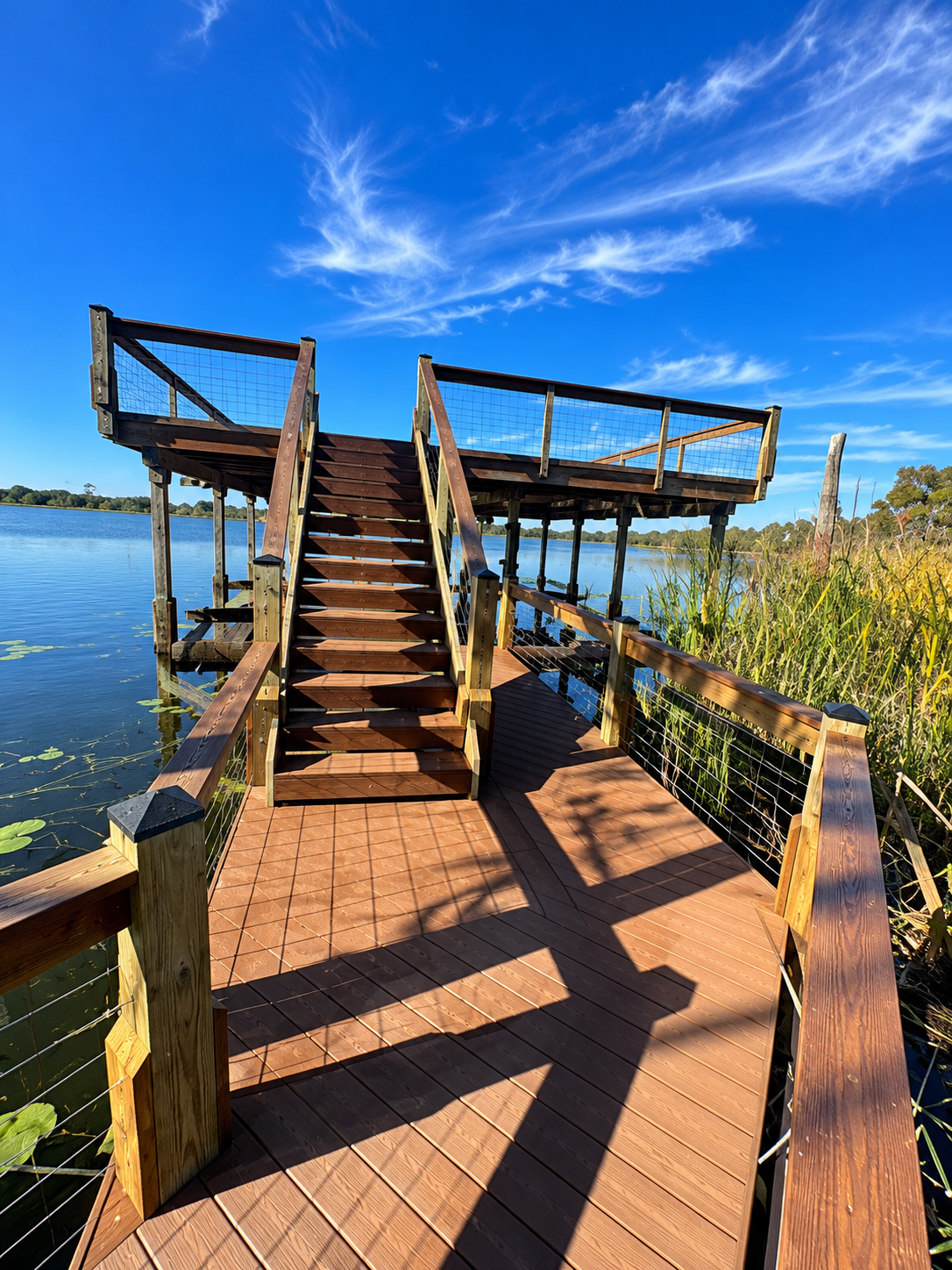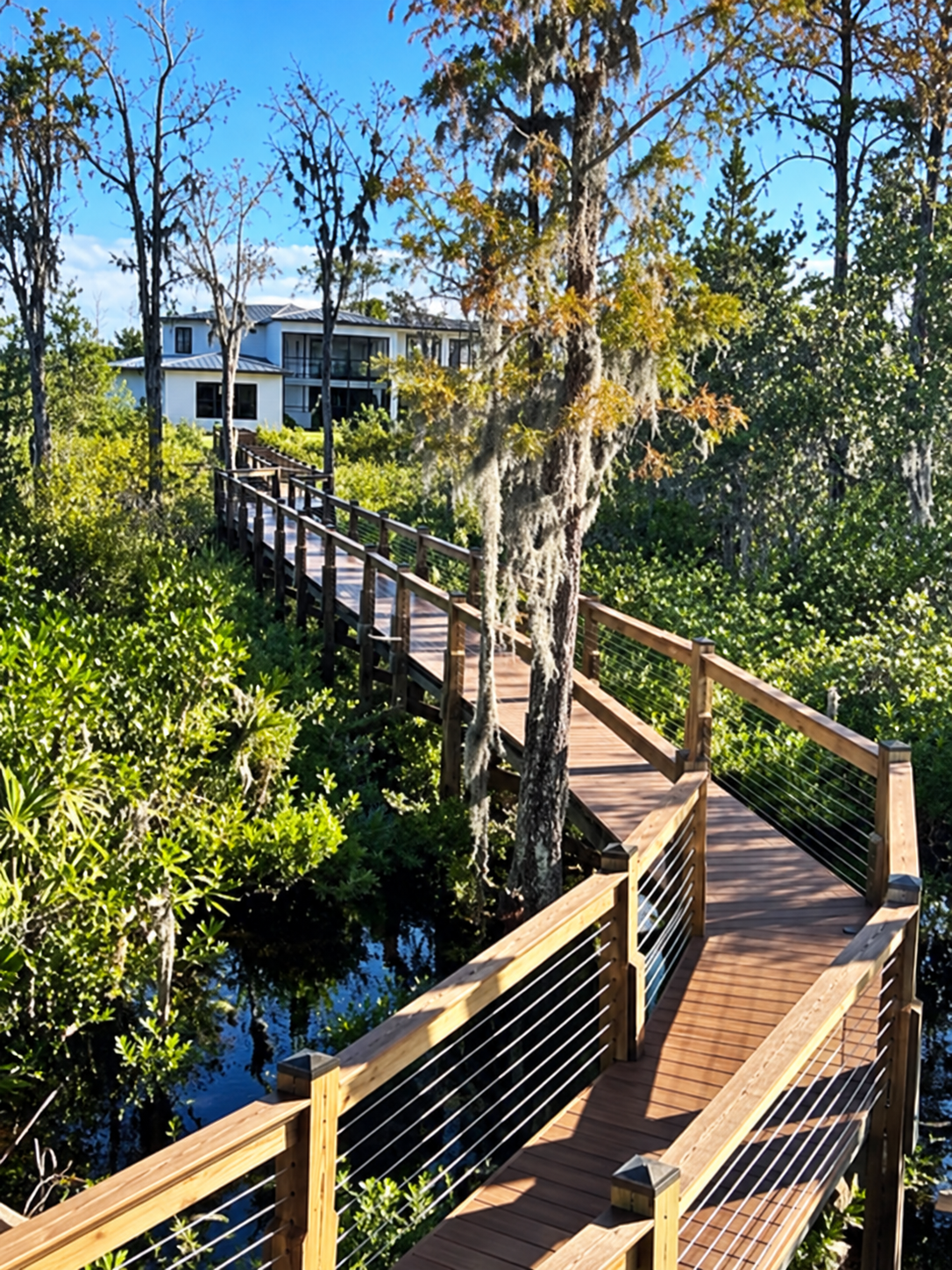
A dock is only as dependable as what holds it up, and what holds it up is the pilings. The part of a dock you walk on gets most of the attention, but the pilings and the foundation are what decide whether the dock is still level in ten years or whether it starts to move after one storm season. Understanding what goes into the foundation is the difference between asking for a dock and asking for the right dock.
A piling is a vertical post driven into the lakebed that carries the weight of the dock and resists the lateral forces wind and water put on it. The depth a piling is driven to is not a guess, it is determined by the soil conditions at your shoreline. A builder checks the bottom during a site assessment, because a firm, sandy bottom holds a piling differently than a soft, mucky one. A piling that is not deep enough will settle or lean under load, and a piling driven correctly holds the dock where it belongs for years.
The material of the piling matters in Florida. Wood pilings, typically pressure-treated southern yellow pine, are the most common choice for residential docks on Central Florida lakes. They are strong, available, and familiar to local builders. The treatment level matters, because a piling that spends its life in water needs a higher retention level than one used in dry construction. A builder who works on Florida waterways knows which treatment is appropriate for the submerged condition, and that choice directly affects how long the piling lasts.
Concrete and steel pilings are options in some conditions, and they behave differently. A concrete piling can be more resistant to marine borers and to the slow decay that wet wood can face, but it is heavier to handle and may require different equipment. Steel pilings are strong and can be driven into harder bottoms, but they require corrosion protection in a wet environment. For most residential lakefront docks, wood pilings are the practical default, and the other materials come into play when the bottom conditions or the project scope call for them.
The way a piling is connected to the dock framing is the next structural detail. A piling that is driven correctly but connected poorly will still transfer movement to the deck. The hardware, the bolts, the brackets, and the way the framing bears on the piling all have to handle both the vertical load of people and furniture and the lateral load of wind and wave action. In Florida, that hardware also has to resist corrosion, which is why stainless or hot-dipped galvanized fasteners are standard on a dock built to last.
The framing that sits on the pilings is the next layer of the foundation. The framing carries the decking, and it has to span the pilings without sagging. The size and spacing of the framing members depends on the span between pilings and the load the dock is built to carry. A dock built for a seating area and a boat lift carries more load than a simple boarding walkway, and the framing reflects that. A builder sizes the framing to the use, not to a generic standard.
Lateral stability is the part of the foundation people rarely see but always feel. A dock that sways underfoot has undersized bracing. A dock that feels solid in a wind has diagonal bracing or a layout that resists lateral movement. In Central Florida, where afternoon thunderstorms and the occasional tropical system put real lateral loads on a structure, that bracing is not a luxury, it is part of the foundation. A builder who knows the region designs for the wind the dock will actually see.
The bottom condition at your shoreline is the variable that most affects the foundation. A firm, sandy bottom holds a piling well and makes for a straightforward foundation. A soft, organic bottom may need deeper pilings or a different approach to reach a load-bearing layer. A shoreline with a layer of muck over sand may require the builder to drive through the soft layer to find firm material. This is why two docks on the same lake, built by the same builder, can have different foundations, the shoreline conditions are not identical.
Storm load is the foundation's real test. A dock built for calm weather but not engineered for a storm may hold for years and then fail in one event. A dock built for the conditions, with pilings deep enough, framing sized for the load, and bracing that resists lateral movement, takes the same storm and stays put. The difference is not visible day to day, but it shows up the season it matters.
The useful way to think about the foundation is to ask what holds the dock up and what keeps it from moving. Pilings handle the vertical load, bracing and connection handle the lateral load, and the material and depth choices determine how long both hold. A builder who assesses your shoreline can tell you what your bottom offers and what the foundation needs to be, which is the real starting point of a dock that lasts.
Ready to talk about your waterfront? We assess your shoreline, your watercraft, and how you use the water, then give you an honest, accurate estimate — no obligation.
Frequently Asked Questions
- How deep do dock pilings need to be?
- The depth depends on your shoreline's soil conditions. A builder checks the bottom during a site assessment, because a firm, sandy bottom holds a piling at a different depth than a soft, mucky one. A piling that is not deep enough will settle or lean under load.
- What material is most common for Florida dock pilings?
- Pressure-treated wood pilings, typically southern yellow pine, are the most common choice for residential docks on Central Florida lakes. The treatment level matters, because a submerged piling needs a higher retention level than one used in dry construction.
- Are concrete or steel pilings better than wood?
- They are options in some conditions, not a universal upgrade. Concrete can resist marine borers and wet decay but is heavier to handle; steel is strong and can be driven into harder bottoms but needs corrosion protection. For most residential lakefront docks, treated wood is the practical default.
- Why does the framing matter if the pilings hold the dock up?
- The framing carries the decking and spans the pilings. It has to handle the vertical load of people and furniture and the lateral load of wind and wave action. A dock built for a seating area and a boat lift needs heavier framing than a simple boarding walkway.
- What keeps a dock from swaying in the wind?
- Lateral stability comes from diagonal bracing or a layout that resists lateral movement. In Central Florida, where storms put real lateral loads on a structure, that bracing is part of the foundation, not a cosmetic add-on.