A boat lift is not a single product, it is a choice among types, and the type that fits your dock depends on the water you are on and the dock you have. Cantilever, vertical, and floating lifts each move the boat in a different way, and each suits a different shoreline and water condition. Understanding the differences is how you choose the lift that works for your waterfront, not the lift that looks the easiest in a catalog.
A cantilever lift uses arms that pivot to swing the boat out over the water and to lower it in. The boat sits on a cradle that is supported by arms that reach out from the dock, and the lift raises and lowers the boat by pivoting the arms. A cantilever lift is a good choice for deeper water, where the arms can reach out without the lift needing a deep frame, and for docks that have a clear area beside them where the arms can swing. The cantilever is a common choice on Central Florida lakes where the water is deep enough to float the boat off the cradle.
The tradeoff of a cantilever is the swing. The arms need room to move, which means the dock has to have the space beside it for the boat to swing out. A dock in a narrow canal or a tight slip may not have the room for a cantilever, and a vertical or floating lift may be a better fit. The cantilever is also a mechanical lift, with pivots and cables that need maintenance, and the maintenance is part of the cost of the choice. A cantilever that is well-maintained is a reliable lift; one that is ignored will have issues.
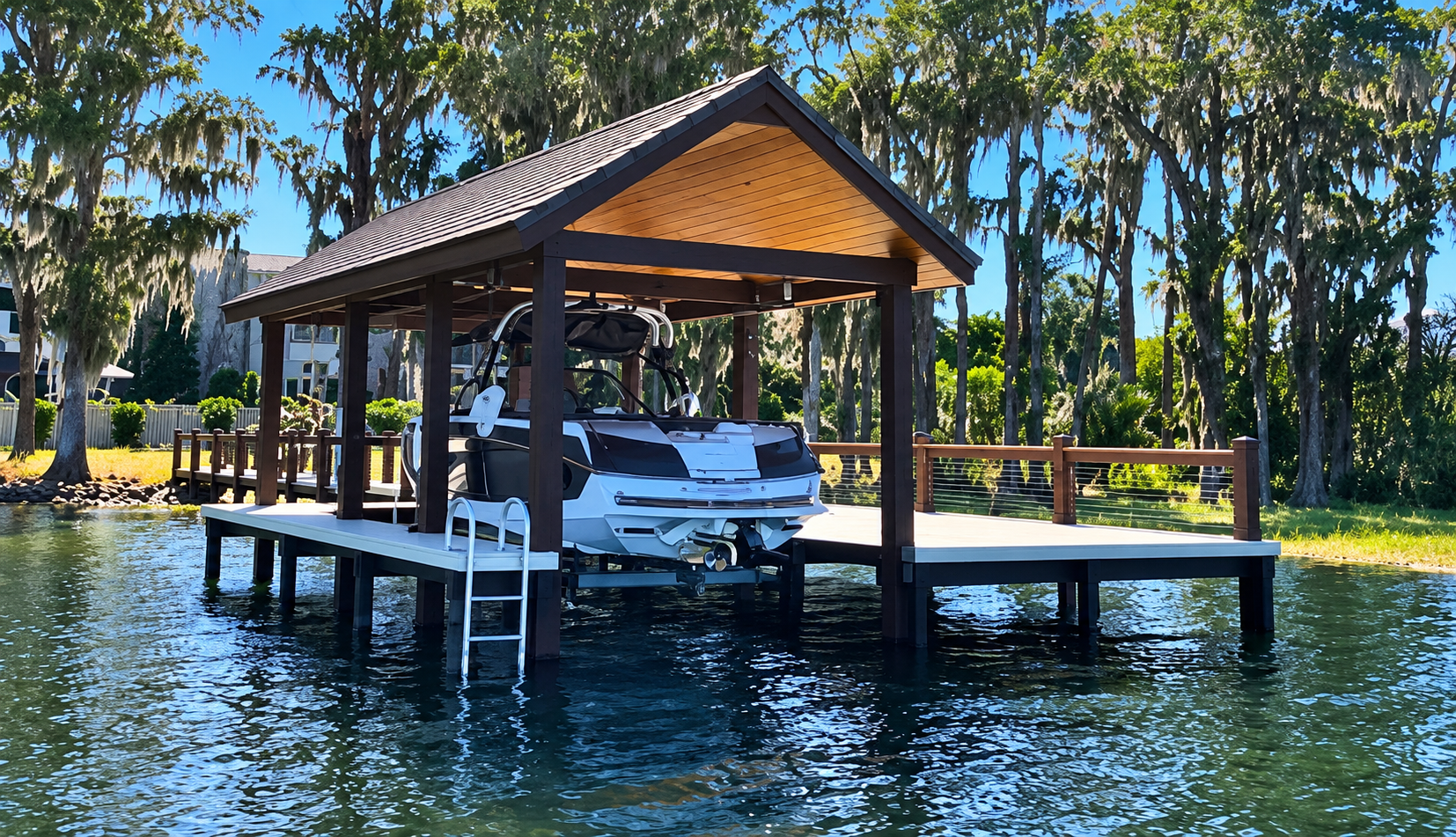
A vertical lift raises and lowers the boat straight up, with a cradle that moves vertically on rails or guides. A vertical lift does not swing the boat out, which means it does not need the room beside the dock that a cantilever does. A vertical lift is a good choice for shallower water, where a cantilever would not have the depth to reach, and for docks where the swing is blocked by a seawall or a neighbor. The vertical lift is the choice for tighter spaces and shallower water.
The tradeoff of a vertical is the frame. A vertical lift needs a frame that guides the cradle, and the frame has to be tall enough to lift the boat clear of the water. In deeper water, the frame is taller and more visible, and the installation is more involved. The vertical lift is also a mechanical lift, with cables and guides that need maintenance, and the maintenance is part of the cost. A vertical lift that is well-maintained is a reliable lift; one that is ignored will have issues.
A floating lift rides on the water itself, with floats that lift the boat as the water rises and falls. A floating lift is connected to the dock by arms or cables, and the lift floats with the water level. A floating lift is a good choice for water that fluctuates, because the lift rises and falls with the water and keeps the boat at a consistent level relative to the dock. It is also a choice for a lighter-touch installation, because it does not require the deep pilings that a fixed lift does.
The tradeoff of a floating lift is the movement. A floating lift moves with the water, which means it is less stable underfoot and more affected by wave action. A floating lift in rough water will move more than a fixed lift, and the boat and the lift will move with the water. A floating lift is also a mechanical lift, with cables and pivots that need maintenance, and the maintenance is part of the cost. A floating lift that is well-maintained is a reliable lift; one that is ignored will have issues.
The choice among the three is driven by the water and the dock. The water depth sets the options. The available space sets the cantilever versus the vertical. The water level's fluctuation sets the floating option. The dock's structure and the shoreline set the installation. Each lift type suits a different condition, and the right choice is the one that matches the waterfront you have, not the one that is cheapest or easiest.
The maintenance is the other consideration, and it is the same for all three. Any mechanical lift has moving parts that need attention, and the maintenance is the cost that keeps the lift working. A lift that is maintained lasts longer and works better than one that is not, and the maintenance is part of the decision. A lift that is ignored will fail, regardless of the type, and the maintenance is what prevents the failure.
The way to choose is to start with the water, the dock, and the boat, and to match the lift to the conditions. A builder who installs lifts on Central Florida waterways can tell you which type fits your shoreline, your water depth, and your dock, and they can give you a realistic comparison of the tradeoffs. The right lift is the one that works for your waterfront, and the comparison is how you find it. The lift is an investment, and the choice is the one that the performance of the lift depends on.
Ready to talk about your waterfront? We assess your shoreline, your watercraft, and how you use the water, then give you an honest, accurate estimate — no obligation.
Frequently Asked Questions
- What is the difference between a cantilever and a vertical boat lift?
- A cantilever lift swings the boat out over the water on pivoting arms, which needs clear space beside the dock. A vertical lift raises the boat straight up on guides, which does not need the swing room but needs a taller frame in deeper water. The choice depends on your water depth and the space beside your dock.
- When is a floating boat lift the right choice?
- A floating lift is a good choice for water that fluctuates, because it rises and falls with the water level and keeps the boat at a consistent level relative to the dock. It is also a lighter-touch installation that does not require the deep pilings of a fixed lift, but it is less stable in rough water.
- Do boat lifts require maintenance?
- Yes. Any mechanical lift has moving parts, cables, and pivots that need attention. A lift that is well-maintained lasts longer and works better than one that is ignored. The maintenance is part of the cost of the lift, regardless of the type, and it is what prevents the failure.
- Which lift type is best for shallow water?
- A vertical lift is often the better choice for shallower water, where a cantilever would not have the depth to reach. A floating lift can also work in shallow water that fluctuates, but it is less stable in rough conditions. The water depth and the exposure should guide the choice.
- How do I choose the right boat lift for my dock?
- Start with the water, the dock, and the boat. The water depth sets the options, the space beside the dock sets the cantilever versus the vertical, and the water's fluctuation sets the floating option. A builder who installs lifts on Central Florida waterways can match the lift to your conditions and explain the tradeoffs.